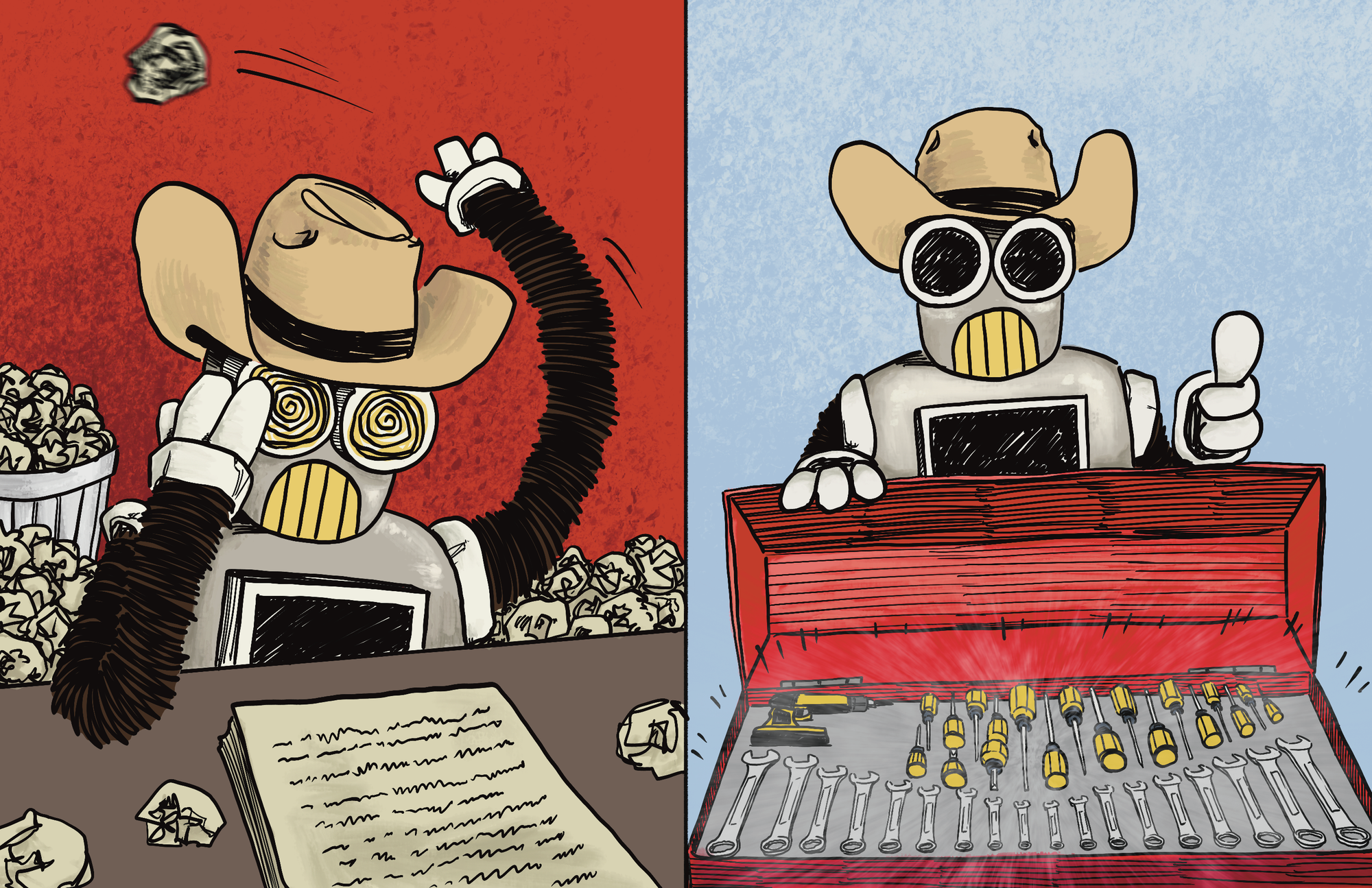
Context Engineering vs. Prompt Engineering

A practical shift in how AI systems are built
Getting useful output from a large language model often feels like a craft. You experiment with phrasing, adjust your instructions, and hope the model understands what you need. But as LLM applications grow more sophisticated, a distinction has emerged that changes how we think about this work: the difference between prompt engineering and context engineering.
Prompt engineering focuses on the specific words you use to instruct the model. Context engineering is broader. It's about managing everything the model sees when generating a response. At PromptLayer, we've watched this distinction become increasingly important as teams move from simple chatbots to complex, production-grade systems. Understanding where each approach fits can mean the difference between a model that occasionally helps and one that reliably performs.
What prompt engineering actually involves
Prompt engineering is the practice of crafting instructions that guide an LLM toward producing the response you want. It's about precision in language: choosing words, structuring requests, and sometimes including examples that demonstrate the desired output format.
The importance of prompt engineering lies in its directness. A well-engineered prompt removes ambiguity. Instead of asking “summarize this document,” you might specify “provide a three-sentence summary focusing on financial implications for small businesses.” That specificity dramatically improves the usefulness of what you get back.
Consider a customer service application. A vague prompt like “help the user” gives the model too much latitude. But a prompt that specifies tone, constraints, and escalation criteria, such as “respond in a friendly but professional tone, never promise refunds over $50, and suggest speaking with a human if the customer mentions legal action,” produces consistent, policy-compliant responses.
Prompt engineering techniques have grown sophisticated over time and now include additional variations, inclusions, and subcategories, including:
- Few-shot prompting: Including examples of ideal input-output pairs within the prompt itself, teaching the model through demonstration rather than description.
- Chain-of-thought prompting: Asking the model to reason through problems step by step, which often improves accuracy on complex tasks.
- Role assignment: Instructing the model to adopt a specific persona or expertise level to shape its responses appropriately.
These techniques work because they clarify intent and expectations. But they operate within a constraint: they only address what you explicitly write in the prompt itself.
The broader scope of context engineering
Context engineering takes a wider view. It's about managing the entire information environment the model processes. This goes beyond just your instructions and includes all the supporting material that shapes the response.
When an LLM generates output, it considers everything in its context window: system prompts, conversation history, retrieved documents, tool outputs, and user messages. Context engineering is deciding what goes into that window, in what order, and how it's structured.
This matters because LLMs don't have persistent memory or real-time knowledge. They only know what you show them. If you want a model to answer questions about your company's policies, you need to provide those policies. If you want it to remember what a user said ten messages ago, you need to include that history.
Key techniques in context engineering include:
- Retrieval-augmented generation (RAG): Dynamically pulling relevant documents from a knowledge base and injecting them into the context, giving the model access to information beyond its training data.
- Memory management: Summarizing or selectively retaining conversation history to maintain continuity without exceeding context limits.
- Tool integration: Providing the model with outputs from external systems such as database queries, API responses, and calculation results.
- System prompt architecture: Designing the foundational instructions that establish behavior, constraints, and personality across all interactions.
We've found that structuring this information thoughtfully often has as much, if not more, impact on output quality than tweaking the prompt itself.
When each approach matters most
The distinction becomes practical when you're debugging or improving a system. If the model understands what you want but lacks the information to do it well, that's a context problem. If the model has all the information but misinterprets your intent, that's a prompt problem.
Prompt engineering excels in scenarios where the task is self-contained. Writing marketing copy, generating code snippets, or reformatting text often depends primarily on clear instructions.
Context engineering becomes more relevant when the task requires external knowledge or conversational continuity. A support agent that needs access to user account details, an assistant that references previous meetings, or a research tool that synthesizes multiple documents all depend on thoughtful context engineering and management.
The most effective LLM systems combine both. You need well-crafted prompts that clearly express intent, operating within a context that provides all necessary information. Neither alone is sufficient for complex applications.
Treating the full picture as one problem
Separating these concepts helps diagnose issues, but the goal is integration. Effective LLM development treats the prompt and the context as a unified system. This is something we think about constantly at PromptLayer: how to give teams visibility into both dimensions so they can optimize the complete picture.
As applications grow more ambitious, this holistic view becomes essential. The prompt tells the model what to do. The context gives it what it needs to do it well. Mastering both is what turns an LLM from a novelty into a reliable tool.
One place this becomes obvious is in agent workflows. A support agent, for example, rarely fails because the wording of the prompt was slightly off. More often, it fails because the wrong retrieval result was injected, conversation history became noisy, a tool returned inconsistent data, or the system lost track of state across steps. Those are context engineering problems.
At PromptLayer, this is the what we help teams see and improve. Agent traces show the full path of a request: which prompt version ran, what context was included, which tools were called, what the model returned, and how the output performed in evaluation. That makes prompt and context changes easier to debug, compare, and ship with confidence.
If you're building agents or production LLM workflows, you can sign up for PromptLayer here.