Claude code pricing: How to save money

Navigating the pricing structure for Claude Code, Anthropic's AI-driven code generation tool, can be daunting. Whether you're an individual developer or managing a team of engineers, understanding costs is essential for budgeting and maximizing the utility of this powerful tool.
What the plans cost at a glance
To get a handle on Claude Code's pricing, it's critical to start with the basics. The standard subscription options include multiple tiers: the Pro plan, priced at $20 per month (or $17 if you choose annual billing), and the Max plans at $100 for 5× usage or $200 for 20×. For teams, premium seats cost $150 per user monthly, with a minimum of five seats required.
For users preferring more flexible usage, the API token-based pricing plays a crucial role. Prices vary depending on the Claude model chosen, from the cost-effective Claude Haiku at $1 per million input tokens and $5 for output, to the powerful Opus 4.5, which charges $5 and $25, respectively. This structure allows users to match their selection to their budget and computational needs.
Choosing between flat plans and token billing
Subscription plans integrate Claude Code directly, offering a fixed cost tailored to individual needs. The Pro and Max plans provide predictable monthly expenses that include a certain level of usage, while the Team plans are tailored to larger groups requiring comprehensive access. These are ideal for users seeking straightforward billing without worrying about token management.
However, when scaling deployments, token-based API billing becomes significant. This pay-as-you-go model charges based on the tokens processed, which can exponentially increase costs if not managed correctly. The ideal strategy depends on the use case size - smaller projects might stick with subscriptions, whereas large integrations might see savings in token-based billing.
Understanding recent changes and rate limits
Anthropic introduced weekly rate limits in August 2025, primarily targeting power users. Designed to curb continuous 24/7 usage leading to unexpectedly high costs, these limits primarily affect less than 5% of users. Additional capacity is purchasable, giving teams flexibility while ensuring they don't hit operational snags unexpectedly. Monitoring expenses effectively can prevent unforeseen budget overruns. Anthropic offers the /cost command for instant feedback on token usage and costs. Administrators can set spend caps in the Anthropic Console to control overall expenses. Using batch processing for non-urgent tasks can halve costs, and prompt caching reduces token usage for repetitive calls, making them key strategies in a developer's cost management toolkit.
Pick the plan that matches how you actually work
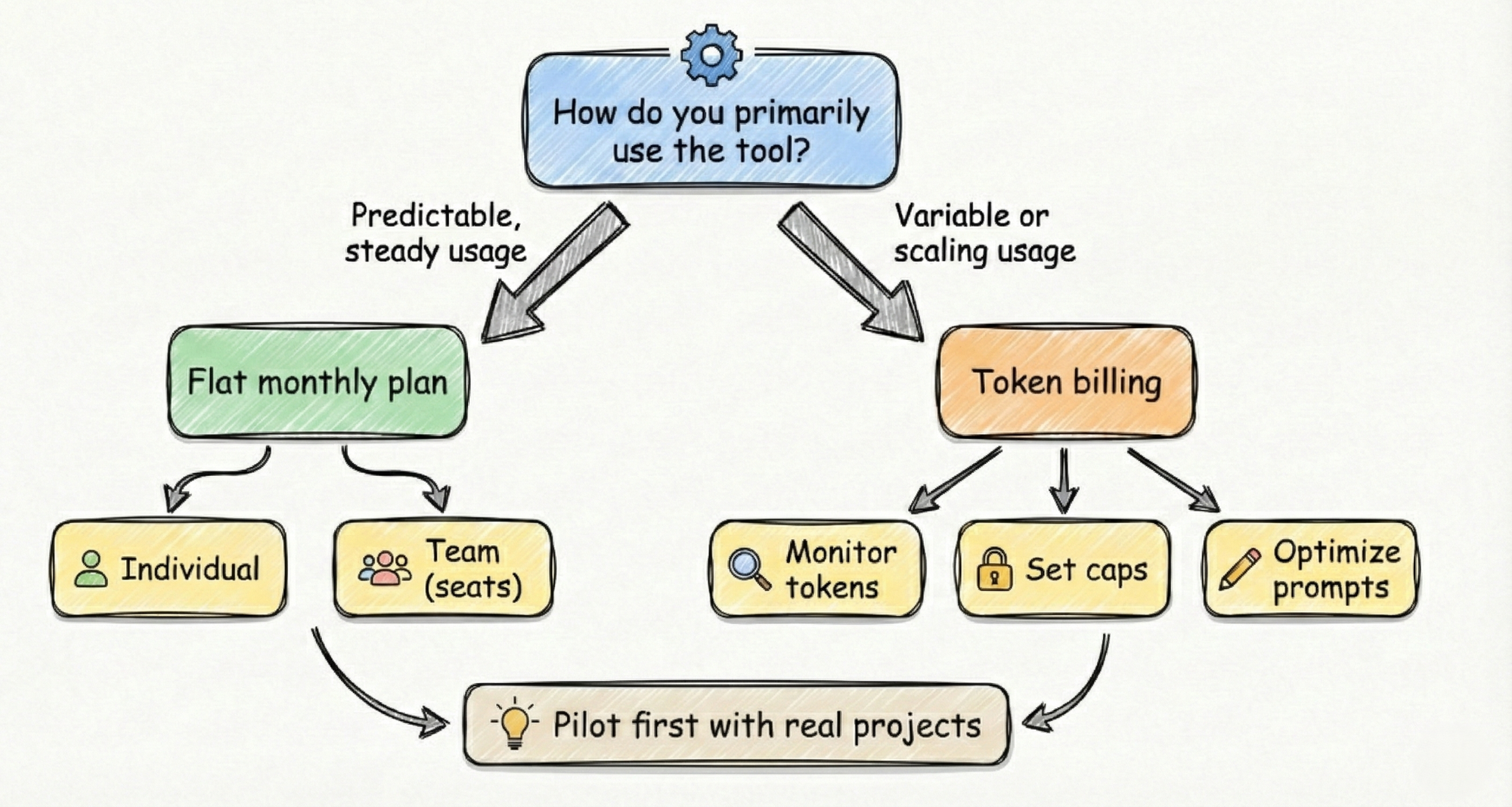
Claude Code gets expensive in only one way: when you don’t treat usage like a first-class engineering metric. Pick the plan that matches how you actually work, then assume tokens will do the rest of the talking - especially when you scale across a team or start running longer, agentic coding sessions.